
By Nora Ziegler
Atheism is a part of religious life. People of faith do not believe the same things equally or consistently and some don’t believe at all. Antitheism separates religious faith from atheism and from radical politics. It is tempting to respond to antitheists by invoking the many religious revolutionaries around the world, whose faith informed their politics and helped them to stay strong and committed in the face of violent persecution.
However, white Christians should be very careful to appropriate revolutionary Christian legacies for our own religious identities. Christianity has been and is a tool of white supremacy as well as of liberation and subversion. The line between the two is bold but it does not always follow the neat boundaries of identity or geography. Sometimes it runs right through us. Sometimes we are at war with ourselves. To understand this struggle, and how religion can be a force of oppression as well as liberation, I believe we need to change how we think about power.

It is hard to grasp power as an individual because power is fundamentally social. Power is always a relationship, whether it is within or between humans, or plants, animals, non-living beings and even deities and spirits. For me, thinking about power has been part of healing from trauma, taking responsibility for my actions and mending relationships with others and with myself. Some of my reflections here may seem academic, but they are also deeply personal.
I have tried to think of power as a relationship between two moments and have called these objective and subjective power. The two can’t be separated but they can become polarized within us, in relationships and across society. Binaries such as objective/subjective are both a means and a result of power. Therefore, to understand power, we can’t assume them as natural, but we also can’t simply ignore or transcend them. This is why I chose these terms, taking seriously Frantz Fanon’s demand that ‘an answer must be found on the objective as well as the subjective level’.i
Objective power is the power we gain by using material and conceptual‘ objects’ such as tools, worldviews, labels, identities. These objects empower us to act, to have an impact on the world around us. At the same time, specific tools, world views or identities also disempower us because they exclude other ways of doing things, other ways of seeing the world, other ways of expressing ourselves.
I am empowered to speak or act and in the very same moment I am limited in my actions and thinking. However, the parts of me and of the world that are excluded, are thereby empowered in a different way. By virtue of being excluded they gain the power to expose the limited and arbitrary nature of the structures that exclude them. This is what I call subjective power: the power to imagine otherwise, to call bullshit, to challenge systems and ideologies we might otherwise take for granted. It is also the power of those persecuted and killed by systemic violence to haunt us and live on in the memories of their loved ones.ii
The problem is, I can’t do both at the same time. I can’t speak and act sincerely while also critiquing my own words and actions. The people murdered in Gaza and Yemen can’t protest outside UK arms fairs. This is why we need other people. Without others to challenge me, I can only speak ignorantly or remain silent .Without others to invoke the memory of the dead, saying their names, holding up pictures, embodying their ghosts in a die-in, those with power over life and death have the final word.
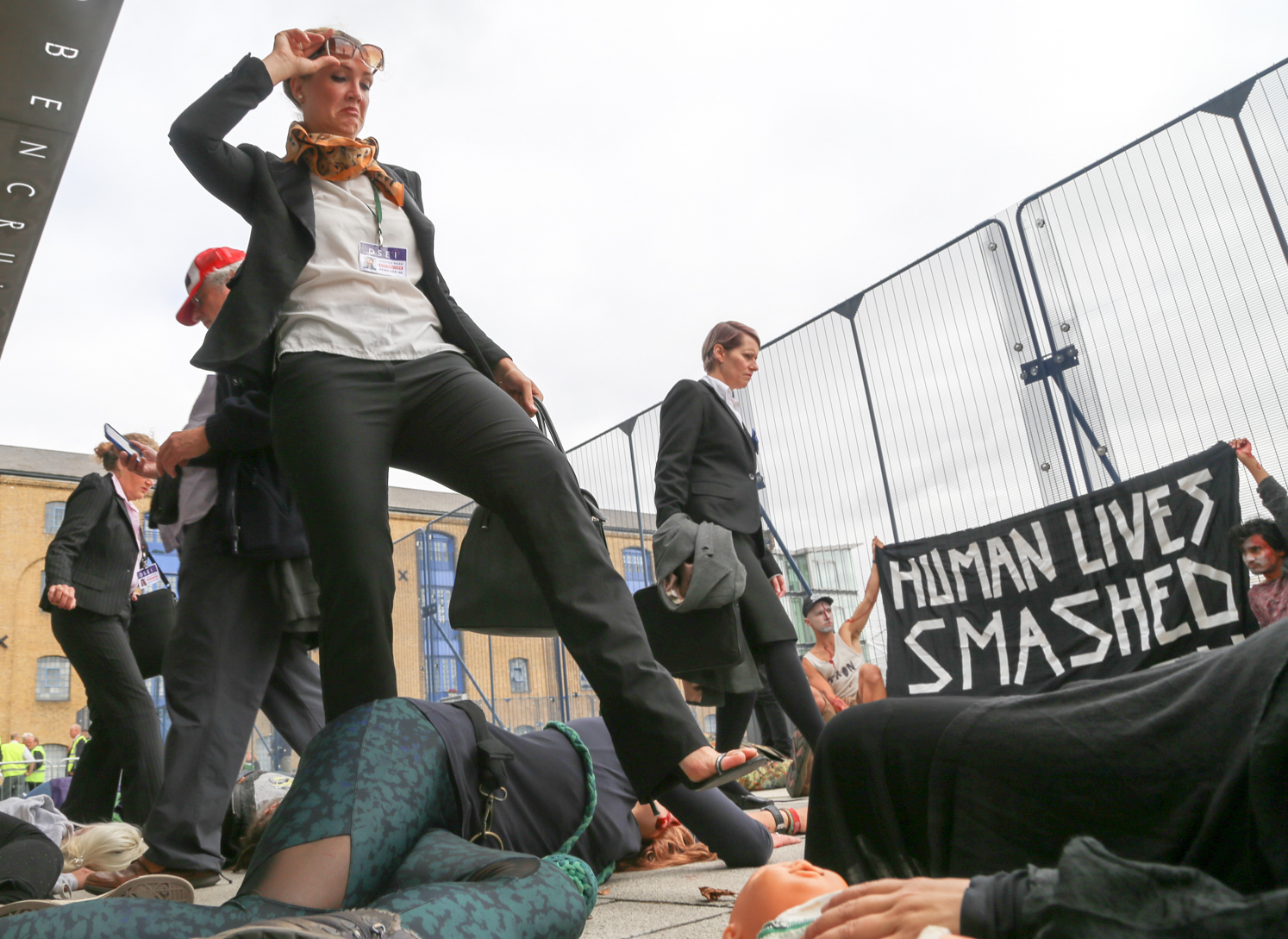
Attendees of the DSEI arms fair stepping over corpses.
Photo credit: Diana More. Published under Creative Commons.
Another way of saying all this, is that we can’t possess Truth and Power at the same time, and yet either is meaningless without the other. They can only be unified in relationships between people, between people and non-human beings, between different movements within and around us. Both are necessary for social change, but they can only be unified by working together in coalitions. This is not a process that we remain in control of. It makes us interdependent and vulnerable to others.
Whiteness is a project that aims to overcome this interdependence. On the one hand, white supremacy is an institution that affords objective power to white people. On the other hand, whiteness overcomes the need for community by constructing an illusionary artificial subjective power: a transcendental rational freedom. Instead of the power to imagine otherwise, whiteness promises the power to imagine anything.
As Chandra Mohanty says, middle-class white people ‘would just like to‘be’, unconstrained by labels, by identities, by consignment to a group’.iii Whiteness functions as an identity and at the same time as an absence of identity, constructed in opposition to Blackness, ethnicity, indigeneity, religiosity, culture, class, queerness, and femininity. It creates an illusion of rational agency by defining the Other as irrational and passive.
Whiteness is an attempt to unify subjective and objective power unilaterally, to control both Truth and Power by creating a universal ‘Truth’ abstracted from the ambiguities and contradictions of real life. Whiteness enables people to dominate while also considering themselves good people. It enables people to create and benefit from an irrational brutal system while considering themselves rational and civilised. As Kehinde Andrews ’argues, whiteness exists as a psychosis to deal with the dissonance between the reality of racial exploitation and white mythologies of modernity.iv
White Christianity has been able to engage in spirituality, indulging in its irrationality, reaching deeply into people’s hearts and fantasies. At the same time, it has framed itself as the only rational religion incontrast to the barbaric and primitive Other. This combination is powerful and impossible to reason with. It makes sense, therefore, that European dissidents wanted to cleave it apart by separating state and religion.
However, secularism and antitheism both help reproduce whiteness. They help define the ‘rationalwest’ in opposition to the religious Other.v Secularism allows liberals and leftists to challenge the authority of religious institutions without challenging the patriarchal and colonial foundations of their power. Antitheism enables leftists to appropriate ideas, symbols, and practices from religious communities and at the same time distance themselves from those communities, secularising, privatising and white washing these practices, making them respectable.
European poets and philosophers ripped off and secularised ancient Greek cosmology as part of the foundation of enlightenment ideology. Already in the mid-19th century, Europeans were travelling to India to learn techniques for spiritual wellbeing that are now ubiquitous in social movements, such as meditation and yoga.vi The ‘dreadlock’ is, among other uses and meanings, a Rastafarian practice that has been adopted by white leftists to express their own political and cultural dissent.
Anarchist academics have adopted concepts such as ‘prefiguration’ and ‘messianic time’, rooted in Jewish and Christian mysticisms. They have tried to retain the revolutionary potential of these ideas while also cleansing them of their mystical and religious content. Techniques for horizontal decision-making and conflict resolution commonly used in social movements, have also been learned from religious groups such as the Quakers and indigenous communities. For example, the ‘talking stick’ originated among indigenous peoples of North America as a spiritual tool for democratic decision making.vii
All these practices are empowering in the ‘objective’ sense because they enable people to make sense of their lives and relationships, express and communicate ideas and put them into practice. However, these practices also ground people in a specific context and worldview. To secularise these practices is to make them universally applicable. Secularisation allows white middle-class leftists to employ such practices independently from global working-class, racialised and indigenous communities. And it helps maintain the liberal illusion that radical social change can be achieved without these communities.
Western leftists have an annoying habit of using specific tactics, structures, and symbols as if they were magically radical in and of themselves in every context. What made these practices radical in the first place was that they express alternative worldviews and metaphysics viii. They rehearse alternative ways of doing politics, of being in community, of being human. They give ‘objective’ form to that which is excluded and only exists as an absence or haunting presence, as ‘subjective’ power, within the hegemonic Western capitalist worldview.
However, turning such tactics and symbols into cultural property also co-opts them into a capitalist colonial worldview. I would like to suggest that white and middle-class leftists who aggressively police‘ cultural appropriation’, are motivated at least in part by a desire to reinforce their political, spiritual, and cultural independence from working-class people of colour. Instead of engaging in cultural practices in a respectful and accountable way, we avoid responsibility by declaring them off limits.
In Islam and Anarchism, Mohamed Abdou argues that respectfully learning and sharing cultural practices requires an ethics of hospitality ix. It requires us to approach ideas and practices that are new to us as guests: listening, learning, and over time developing the experience and confidence to welcome and teach others. Again, this is not a process we can remain in control of. Hospitality means taking an interfaith and coalitional approach. It has the potential to corrode boundaries between theself and other, subverting whiteness, and empowering us to collectively challenge white supremacy.
This requires building mutual trust across some very entrenched and painful divisions, and trust takes time. A lot of activists and leftists act as if we don’t have time forbuilding community and coalitions. But, echoing the words of Bernice Johnson Reagon, I believe we must try to take an ‘old-ageperspective’ x. That means imagining that we will be doing this work together for decades and it is worth learning shared spiritual practices that will ground us in diverse, interconnected, resilient and militant movements for justice.
i) Frantz Fanon.1952.Black skin, white masks
ii) Avery Gordon. 2008. Ghostly matters: haunting and the sociological imagination
iii) Chandra Mohanty. 2003. Feminism without borders: decolonizing theory, practicing solidarity
iv) Kehinde Andrews.2016. ‘The Psychosis of Whiteness: the celluloid hallucinations of Amazing Graze and Belle’. Journal of Black Studies
v) Erica Lagalisse. 2019. Occult features of anarchism: with attention tothe conspiracy of kings and the conspiracy of the peoples.
vi) Leela Gandhi. 2006. Affective communities: anticolonial thought, fin-de-siècle radicalism, and the politics of friendship.
vii) https://www.du.edu/conflict-resolution/news/significance-talking-stick
viii) Cedric Robinson. 1983. Black Marxism: the making of the black radical traditon.
ix) Mohamed Abdou. 2021. Islam andanarchism: relationships and resonances
x) Bernice Johnson Reagon. ‘Coalition Politics: Turning the Century’. Home girls: a black feminist anthology (edited by Barbara Smith)
 Bad Apple Magazine