
By Henry
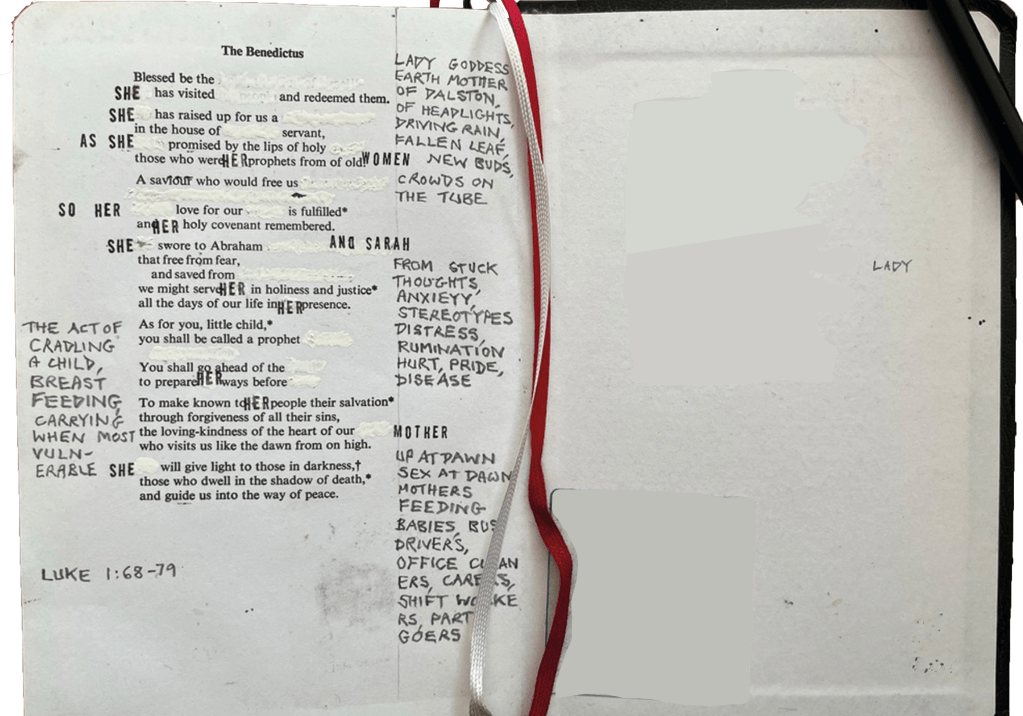
Like many, I have scraps of verse, mostly psalms and poems, in the back of my mind, ready to be called on as needed. I quite often forget the order of the lines or change them around so much that when I see them in print they seem all wrong.
One of these, ready to be called on in a new enquiring period of life, is the Benedictus. Turning sixty, I discover, brings new struggles, in which I grow to accept things are not as they seem, in which familiar prayers and meditation lose their power and others take their place. Where prayer had once seemed to be genderless or mostly male, I needed to bring the feminine part of me into prayer. At this particular time of life, yes, in the practice of prayer, the masculine voice prevented me from finding meaning.
The Benedictus is taken from the words Zechariah says over his new born son. [Luke 1: 68-79] Elizabeth and Zechariah seem like down to earth people. Zechariah doesn’t believe the angel who announces they will have a child, because his wife is ‘very old’. As a punishment, he loses his ability to speak. An echo of Sarah who [doesn’t] appear in this passage, when she laughs and hides in a tent. Zechariah regains his speech when he says, ‘His name is John’.
In the Catholic Church, the Benedictus is a ‘canticle’ said during ‘Lauds’, or morning prayer. As a layperson, I mostly heard it when a male priest led my congregation. Now, in this new period of my life, the lines I had learned by heart through much repetition was not at all what I wanted to say. As they appear in the prayer book, isolated from their context, the story of Elizabeth and Zechariah, some words are war like and vengeful. ‘Mighty saviour’, sometimes translated as ‘horn of salvation’, sounds patriarchal and militaristic. I didn’t want to cast anyone as ‘foes’ or ‘those that hate us’.
One evening I found myself reciting the Benedictus from the point of view of a woman, talking of a woman.
As soon as I changed the pronouns from ‘he’ to ‘she’, I was filled with compassion. If I gave God a new gender, thoughts of life, earth and renewal took the place of anger. The words were suddenly close to me, they lost their distant authority and became personal. They guided me to think of creation. They awakened in me a kind red spirit with the cats and foxes and pigeons, fellow travellers in my street, on the tube, in town. They directed me to my own experience as a mother, daughter, grandmother, a woman long past child bearing age, just like Elizabeth. Just like Sarah.
The lines contain a wonderful promise for the future, even in times of stress, ending on a prayer for peace. It is a promise to two older people, full of hope and love and compassion. The promise, not of a baby, being long past childbearing age myself, but constant reappearance of love, to be cherished wherever I am.
But I really only understood this by disrupting my rote learning and changing the pronouns from masculine to feminine, deleting words, swapping others.
Reciting the Benedictus is something I do in my head. I change the words according to the seasons, places, the amount of time I have, and what mood I’m in. To present my version on paper, I have set it out as a page of a prayer book, with options, which seems fitting for a practical theology. The act of writing in to the prayer book for this page was contemplative itself.
If you are familiar with this song, try changing the words, and add your own names and places.
 Bad Apple Magazine