
By Ghazal Tipu
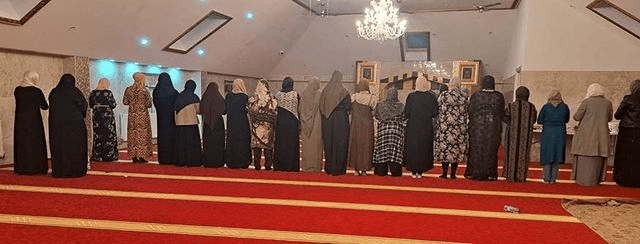
It is common knowledge that a mosque is a man’s space that he has carved as his own spiritually and institutionally. There is often limited or no space for women to pray. It is no surprise that Muslim female campaigners have been calling for increased mosque space for women for some years. Earlier this year, the Open My Mosque campaign launched a report finding that 59 percent of respondents had female friends or family unfairly or negatively treated in a mosque. There were also accounts of women being blocked from entering, including two who had been violently blocked from entering a mosque in London.
The prayer space is often adapted to meet a man’s needs, particularly around the increased numbers of worshippers during Ramadan. Islam is pragmatic and provides women the option to pray at home. Indeed, this is part of the lofty station afforded to women as mothers. The Prophet Muhammad, may the peace and blessings of Allah be upon him, famously said: “Heaven lies at the feet of mothers”. But due to patriarchy, over two thousand years of Islam’s evolution has resulted in women not being guaranteed a place at the mosque. This is not harmonious with the ethos of Islam.
It is often cited that praying in a mosque is mandatory for men and merely optional for women. This common attitude which shapes the male Muslim psyche fails to realise the potentialities for Muslim women in their full participation of mosque spiritual and civic life, as well as the benefits of a dedicated sacred space for women. Like a church, synagogue or gurdwara, a mosque is also more than a place of worship. It is full of institutional potentiality to serve the spiritual, emotional and practical needs of the Muslim community. The Easton Jamia Mosque in Bristol provides support and activity days for elderly women and men, while the Maryam Centre in East London provides counselling service for women, to name a few examples.
More sophisticated mosques also connect with the social and political fabric such as faith groups, media, education, the Establishment and civil society leaders. Since it is the Imam and the mosque committee – who are virtually always men – who represent the mosque, the female worshippers often do not have direct contact with their local civic local leaders through their local mosque. This stunts their potential to represent their faith in British civic life.
One Ramadan, I visited my hometown in Kent. The mosque invited local civic leaders to a community iftar. The male local leaders gave a speech on the men’s side, while the women, including a local policewoman and prospective parliamentary candidate had the opportunity to engage with the female worshippers within the female prayer space. While this was a positive initiative, it was disappointing that these two local female leaders were not provided a platform to give a speech to the female and wider congregation, unlike their male counterparts. This would have role-modelled female leadership.
The way our environment is structured spatially constitutes our reality. Even the mosque architecture lends itself to women being othered. The “piece de resistance” of the mosque is the dome that is positioned over the men’s area on the ground floor. This dome is often the aesthetic centrepiece of the mosque. The women’s section is often upstairs, at the back, or in a basement. The main section with its adornments is reserved for the men as if they are the main attraction.
These limitations for women suggest the need for a provision more radical by the founding of a women’s only mosque in the UK. Such a mosque would be a place to gather unscathed, to feel a sense of belonging and to feel comfortable in your own skin as a Muslim woman. We need spaces for women to lead spiritually and to be visible to their congregation to facilitate organic interaction. In current mosque practice, the Imam or speaker is the spiritual leader that a male member of the congregation can approach without fuss. The reality is that a woman will have to arrange to speak to the Imam about a spiritual or pastoral matter. What would be even better is a women’s only mosque with a female imam who is available to engage with her congregation in the prayer space.
A women’s only mosque has been realised before in Copenhagen, Los Angeles and throughout China’s history. While we do not yet have such a mosque in the UK, the Inclusive Mosque Initiative which describes itself as an “intersectional feministic mosque” is bridging some of the gap and re-imagines the mosque as a place that puts women’s leadership front-and-centre as well as is supporting queer Muslims. This initiative supports the training of female Imams, provides a monthly Qur’an discussion group aimed primarily at women, nonbinary and genderqueer Muslims and provides regular prayer events online and in-person which practices Islam in an inclusive feminist environment, often led by women. It’s a start.
 Bad Apple Magazine