
Reham Bestawi
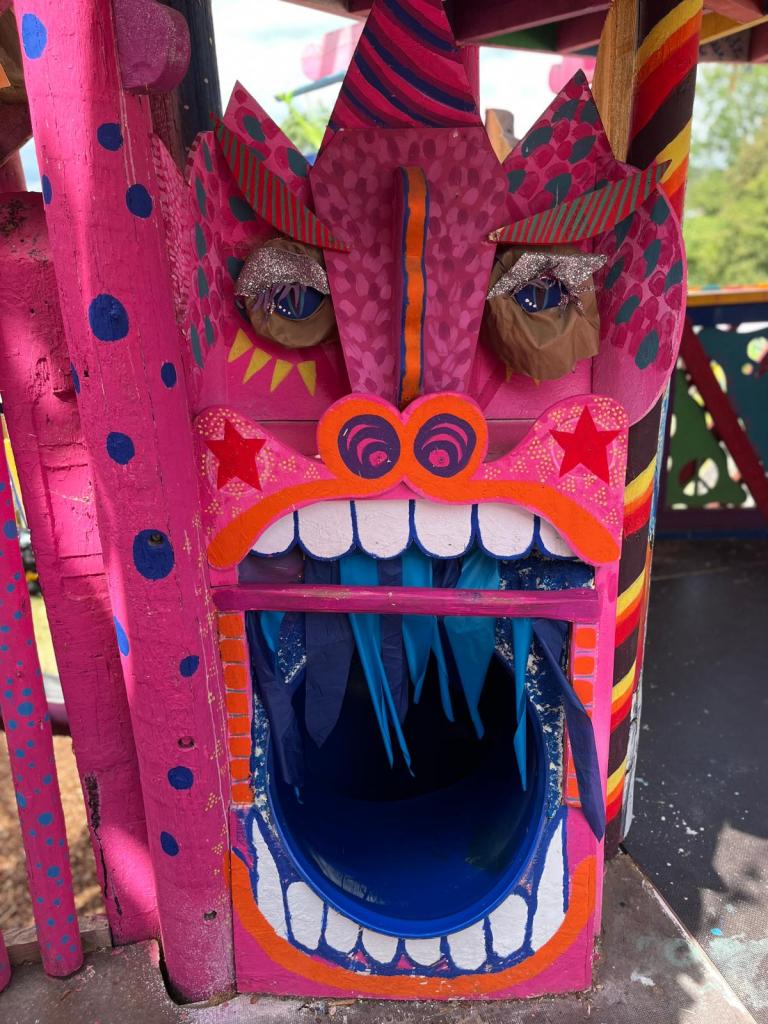
Play is not a luxury. It’s essential for life, something we are entitled to carry throughout every moment of our waking lives.
I am aware this is easier said than done, especially considering the deep grief I carry for the destruction of my homeland Sudan, and the violence inflicted on my people, and my white-hot anger for the ongoing genocide of Palestinians. When I experience joy, there’s a heavy weight of guilt that looms over me.
‘How can I experience joy while people, my people, suffer?’ I become stifled. Coming from a place of suffering, however, I have found radical power in play. Through play I gain the resources and inspiration needed to show up in solidarity.
This summer I went to the Glastonbury Festival for the first time ever, on a working ticket with Kidzfield, taking pictures and videos.
Despite the commerciality of the shops, food concessions, the world famous acts, despite the expense of Glastonbury, being there felt amazing! In particular, I found a hidden gem in Kidzfield. I was blown away by the abundance of it all. I was amazed at how much effort was put into building a space for a childhood dream.
I found it awesome and radical that Kidzfield held the space in such a way. With the ever-encroaching monster of the commercialisation of what was once a free party, Kidzfield fights against it with love and play. During the opening meeting of the crew of Kidzfield, the organisers gave a speech about why Kidzfield was there, and the part we were to play in it. They emphasised anarcho-syndicalism, meaning the opposition to unjust, unnecessary hierarchies and transferring ownership of the means of production to the workers. In other words, we were to be responsible for ourselves and responsible for each other.
Spending time with the crew of Kidzfield got me wondering why they were so willing to put this much effort and heart into a space for kids.
I came to understand that it’s not just about keeping kids entertained so that the parents can have a break; it’s about keeping all our childhoods alive. It’s about encouraging parents too to relive their own childhoods with their kids and seize the opportunity to connect as a family. This is important because our dysfunctional society under the gaze of capitalism and the unsustainable nature of the ‘nuclear family’ doesn’t really allow for parents to have opportunities to spend time with their family in that way.
One balloon animal artist said that, in their adult years, Kidzfield was the first time they got to experience a childhood, and it helped them feel happier because they finally felt comfortable enough to play. Most believe that the kids who visit Kidzfield learn a lot during the four days of the festival, through play, the arts, and the invitation to be curious. The impression I got from the crew is that there’s a moral obligation and responsibility to prioritise childhood, with the hope that this will encourage the development of secure adults, human beings. A gentle approach to act against capitalism’s impact on childhood.
Everyone involved was very passionate about the importance of nurturing one’s childhood throughout one’s lifetime.
The mantra for Kidzfield is Freedom, Magic, Joy. As Bob would say, FMJ.Freedom to be yourself, Magic to imagine a world full of wonder, and to sincerely enjoy yourself! That’s my interpretation of FMJ.
I thought of the impact Kidzfield could have on someone who’s visited it. When being there you see and feel the excitement, it’s almost like electricity, and the level of engagement in various activities that children had was like nothing I’ve seen before. Hearing the laughter and sounds of amazement, seeing the bright colours of décor and outfits hugging around you with a sea of welcoming smiles, and a holy view of the bright pink castle, was very healing for me. The inner child felt seen and felt given a sense of belonging and safety to play.
The experience highlighted to me the significance of play. I felt a change in me. I felt lighter, and even silly!
When we play, our nervous system is in ventral vagal, which in neurology means we feel safe and social, most regulated, and not acting from a fear state. We get curious, we become imaginative and that’s vital for revolution.
An example of why play is a useful tool in revolution is that systems of oppression have a sinister way of becoming assumed as a part of culture. As we work toward breaking down these systems of oppression, I draw inspiration from visionary feminism. Its foundation is the power of imagination, to envision a world where there is genuine equality for people of all genders. To imagine is to be curious, and curiosity is best friends with a cat called ‘play’.
In the face of rupture or conflict, getting curious and playful can provide such beautiful solutions to a difficult situation, whether that be a misunderstanding with a partner or friend, or conflict within yourself, or the world. The solutions are beautiful because they are not coming from a place of fear, rather from love and compassion. Don’t get me wrong, ignoring fear is not what I’m suggesting; it’s important to acknowledge it. Our fear is trying to do its job to protect us, even if it means protecting us from ourselves. Trying to resolve a problem and aiming for an outcome that is rooted in love and compassion starts with recognising where you are at and being honest about where you’re coming from. Of course, recognition is not an easy task, and on top of that having the tools and resources to get out of a state of fear is even harder. But I wonder if we were to get curious, we’d at least make the first step toward recognition. A friend once told me, ‘Being human is a lifetime project’, but I like to add my own twist to it, ‘Being human is a lifetime story.’ So be playful, ask why and learn your story.
 Bad Apple Magazine