
Vida O’Riordan
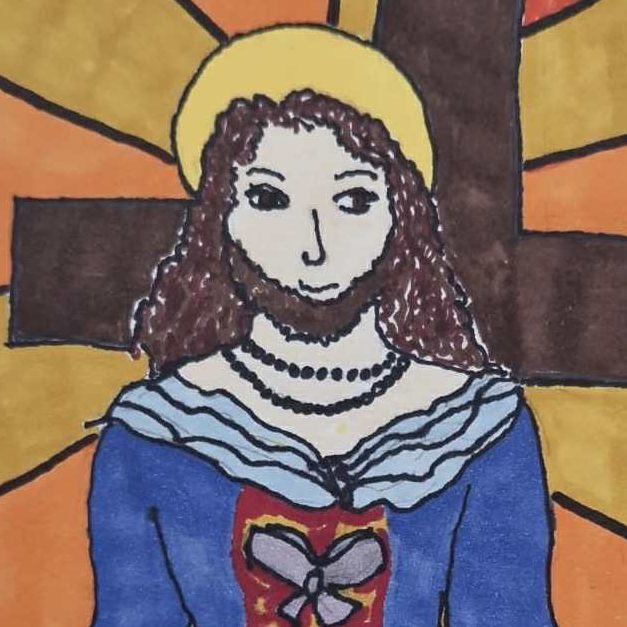
Saints and their often morbid lives have fascinated me since my confirmation as ‘Lucia’—the saint who gouged out her eyes to escape marriage. I found her story, and defiant depictions empowering. So when my partner suggested we reclaim queer and feminist saints through art, I was excited. Xe researched their stories, then we both started drawing in our unique styles. Xe explored the ‘grotesque’ as subversive power, and I focussed on the vibrant ‘life-spirit’ of their lived humanity.
A 14th century Portuguese princess, Wilgefortis, prayed for deliverance from a forced marriage, which would break her virginal vow of celibacy to God. She miraculously grew a beard, her arranged suitor found this unacceptable and called off the wedding. Her father was furious and had her crucified. Wilgefortis’ determination to keep her vow of virginity to God in contradiction to her father’s demands mirrors today’s understanding of reproductive justice. She fought to the end for her bodily autonomy despite facing physical abuse and ultimately crucifixion, reflecting her moniker which translates to the ‘strong/courageous virgin’.
A pillar of reproductive justice is the right not to have children. Wilgefortis actively rejected the sexual and reproductive expectations placed upon her by a patriarchal society. This is a theme of virgin saints fighting to keep a vow of chastity that arises in other saints my partner and I have chosen to draw, including Saints Agatha, Lucia and Joan of Arc who was also famously gender non-conforming. Her subversion of the body from ‘property’ to ‘defiant force’ offers sanctuary to trans, asexual, and queer people today. Queer people and women continue to face threats of violence and death everyday. Wilgefortis can be seen as a symbol of gender and sexual rebellion, who provides comfort and inspiration.
Wilgefortis is also known as Saint Uncumber which represents the act of being freed from a burden, her fight for liberation. Her story reflects her fight for sexual self-determination, and her resistance to domestic abuse, forced marriage, sexual violence, and gendered expectations around expression and behaviours. She became a popular saint to pray to for those in forced or abusive marriages. Her popularity spread around Europe and South America. She even has a statue in Westminster Abbey. Her veneration lasted until the end of the 16th century when the church suppressed worshipping her.
Wilgefortis reminds me of my partner who has Portuguese descent, experiences on the asexual spectrum, and has hirsutism and wears xir beard with gender queer pride. I intentionally drew Wilgefortis to look similar to my partner who has been a creative influence on me in the past few years. Xe has helped me understand the stigmatizing experiences of ‘bearded women’ within society. Wilgefortis being chosen as a people’s saint provides much needed affirmative representation of gender non-conforming people in the church, particularly here in challenging normative beauty standards and reclaiming body hair. Even if someone doesn’t believe in her story or miracle, they can’t deny that ‘bearded women’ exist – a lot of people’s only reference is through derogatory ‘freak shows.’ Today many people will know through intimate relationships with partners, family members and friends, that facial hair is a reality for people of all genders. Whether we can see the hair or not we know this remains a highly political issue 700 years later!
Vida O’Riordan (they/them) is a Brighton based artist and crafter. You can find more of their work on Instagram @mossybits.
Franky Green (xe/xir) is a genderqueer artist, musician and academic. You can find xir on Etsy or Instagram (@rallying.reverie).

